

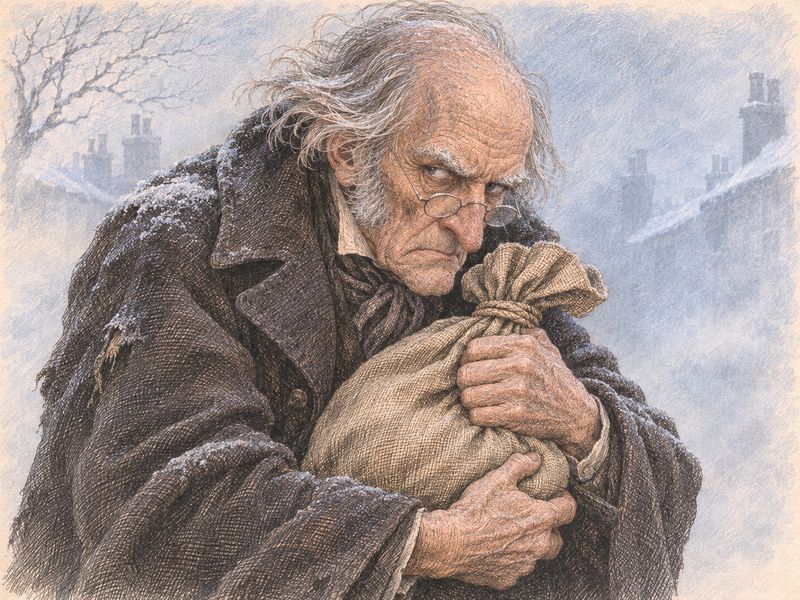
A Christmas Carol has a really simple plot: Scrooge is a selfish old miser who learns the error of his ways and changes. This makes it a great text to write about though, as it gives a clear process that the character goes through. Most of the quotes will either be about who he was, how he changes, or who he becomes. Also, it means your essays will normally follow a structure: show how he was before, then how he changes, and then who he became.
Even the other themes - compassion, family, greed - can mostly be built into this formula: how does family change him? How does he learn compassion? What is Dickens saying about greed? By structuring your answers around this simple plot you will (mostly) be able to get by.
It’s also worth saying that it’s a great plot for other reasons: literature should really teach us something about us or our lives. Scrooge’s journey is one that we can all learn from. We all have times where self-pity drives us to selfishness and it’s often hard to see that process happening. Through literature (and stories in general) we should question our own behaviour. One important way to look at literature is as a way to live our lives through others, to learn lessons through other people’s suffering. By learning Scrooge’s lesson through his behaviour, we don’t have to learn it through our own and, in many ways, this is the best Christmas present this book can give...
Plot by Staves
Stave 1: Marley's Ghost
- We open with a long description of Scrooge
- The story starts proper in his counting house where he is visited by Fred, two Portly Gentlemen, and a carol singer.
- After eating alone he returns home and sees Jacob Marley's face on his door-knocker
- Jacob Marley arrives, draped in chains, and tells him that if he doesn't change his fate will be even worse
- Marley says that three ghosts will visit Scrooge and try to show him how to change
Stave 2: The Ghost of Christmas Past
- The Ghost of Christmas Past is a crazy representation of the past - and it looks a bit like a candle
- They visit Scrooge's school where he sees himself as a lonely boy but was saved by his sister, Fanny
- We visit his old workplace where he remembers how much fun he had with Dick
- He then goes to see the moment his fiancee returned his ring, saying he was to materialistic
- After seeing his ex-fiancee with her new family he gets really angry and snuffs out the candle of the past
Stave 3: The Ghost of Christmas Present
- The Ghost of Christmas Present arrives sitting on a massive pile of lovely stuff
- Scrooge and the ghost visit Christmas celebrations in London, where everyone is having fun
- They then visit The Cratchit's house, where they are poor but happy
- Then they go on a tour of England's Christmases where, despite difficulties, everyone is celebrating Christmas
- They end up at Fred's dinner where Fred insists on toasting Scrooge
- At the end of the stave, the ghost reveals two children under his robe - Ignorance and Want - who he says will destroy mankind unless something is done
- A phantom approaches Scrooge
Stave 4: The Ghost of Christmas Yet to Come
- The Ghost of Christmas Yet to Come is dressed like the Grim Reaper, as a reminder of the future that awaits us all
- He takes Scrooge to see some bankers who are talking about someone who has died - they don't really care
- Then they go to see Scrooge's old maid who is selling some of Scrooge's possessions
- Scrooge asks to see someone who is emotionally affected by the death and they visit a couple who are celebrating it as it will ease their repayment plan
- Then they visit the Cratchits who are mourning the loss of Tiny Tim
- Then Scrooge sees his own grave and promises to be different in future
Stave 5: The End of It
- Scrooge is a new man!
- He gives Bob Cratchit a pay-rise, pays some money to the Portly Gentlemen and visits Fred's for Christmas dinner
Freitag's pyramid
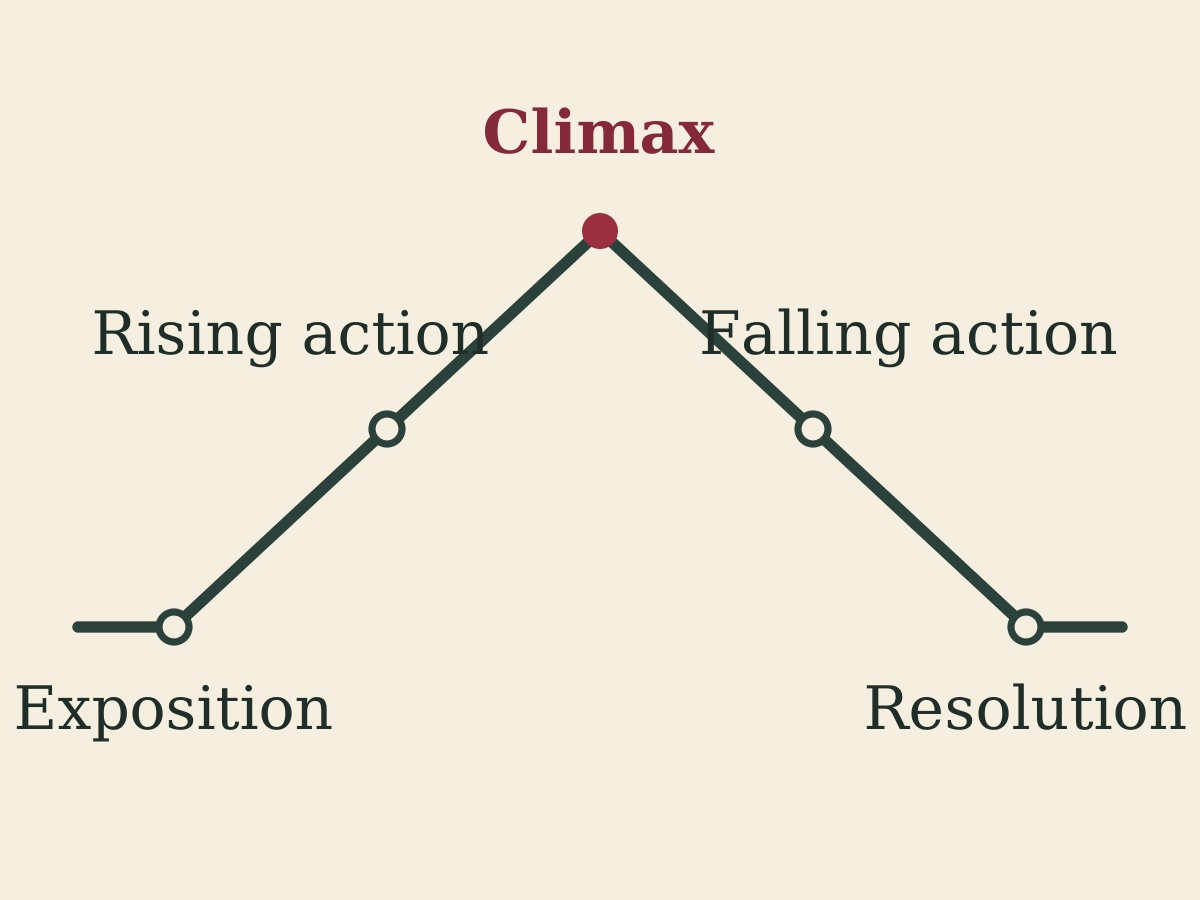
You can layer the book neatly onto Freitag’s pyramid, which is an academic way to look at plots. In many ways the pyramid seems frustratingly simple, but academic’s love a structure and it’s not a bad thing to mention if you can remember it.
The concept is simple: Stave one is the exposition - which just means the part of the plot where the goal is established. Good examples of exposition might be the bit in every James Bond movie where he goes to see M and is told that there’s a baddie out there who’s gonna take over the world and this is what he’s up against - my favourite is this one from GoldenEye . There’s really clear exposition here: they’ve got a weapon, here’s the baddie, and we need to stop them. Through this scene is also memorable for Bond and M’s legendary exchange! Probably the most famous piece of exposition in cinema history is this sequence in Raiders of the Lost Arc where they explain the significance of the Arc. The whole plot is laid out: get the arc before the Nazis. Now go!
In A Christmas Carol, the exposition is this: Scrooge is selfish and if he doesn’t change he’ll be condemned to a kind of purgatory - the hellish existence that Marley describes.
The Rising Action is the book is interesting. I’d argue that each of the ghosts have their own rising action and Climax. So each works as a kind of short-story in their own right.
For the First spirit, the Rising Action is the understanding that he was once a good man but turns to the Dark Side through fear of the world; the Climax comes when he snuffs the candle out.
In the second, the rising action comes through how nice everyone is about him, then the climax comes when he faces the children and the spirit dies.
For the third spirit, again, the Rising Action is understanding how much everyone hated him, then the climax is seeing his own grave.
Each of these cycles drives Scrooge closer and closer to change.
In the novel, the Falling Action and resolution each happen in the final stage. The Falling Action is that whole section where he gives Bob a pay rise and goes to see Fred, etc…
Then the Resolution is really just the last two paragraphs, from “Scrooge was better than his word.” This just establishes that this is the end of the book. Scrooge learnt his lesson and went on to become a better man, and remained one for all of his living days.It’s designed to let the reader know that all is well, and it will always be well in this world; it is now safe to close the book safe in the knowledge that the story is over and all is well.
Modern stories tend to have a real issue with the Resolution as modern storytellers are obsessed with creating sequels so they constantly leave readers and viewers with unfinished threads and open plot lines. I have a bit of an issue with it, but that’s for another time…
During the opening of the book Scrooge is presented as a pretty horrible guy - he's a "a squeezing, wrenching, grasping, covetous old sinner" who thinks poor people should either be sent to jail or just hurry up and die! He refuses invites for dinner, is horrible to his clerk and to a local carol singer, and spends his life alone.However, even at this early stage Dickens suggests that Scrooge is capable of something more. He's most famously compared to an "oyster" - which is something with a hard shell, but which produces pearls out of sand in one of the most wonderful metamorphoses in nature.
When he is visited by the ghost of Jacob Marley, Scrooge is told that unless he changes he will be punished after death. The punishment is interesting though as it really is just an extension of what he was while he was alive. Marley, like Scrooge, was obsessed with money and when he dies this passion becomes a chain made of padlocks and ledgers and safes - all the things he used for his work - that weighs him down.
In certain respects, this fate suggests that unless Scrooge changes he will remain the same way forever, even after death; this sounds deceptively obvious when you put it like that but is actually a really wise observation. We all have things that we'd like to change about ourselves, and all Marley observes is that unless Scrooge changes he will remain that way.
As I say it seems obvious really: you either change or you will remain the same; but it's amazing how many people in the world don't seem to understand this simple truth.